

Table of Contents
- Understanding Pelvic Floor Damage After Childbirth
- When to Start Pelvic Floor Therapy Postpartum
- Pelvic Floor Assessment After Childbirth
- Postpartum Pelvic Floor Exercises: Gentle Progression
- Postpartum Urinary Incontinence Treatment Options
- Returning to Daily Activities and Exercise
- Finding and Accessing Pelvic Floor Care
- Frequently Asked Questions
Last Updated: October 21, 2026
Understanding Pelvic Floor Damage After Childbirth
Pregnancy and childbirth place enormous stress on your pelvic floor muscles, which support your bladder, bowel, and uterus. When stretched and strained during delivery, they can weaken significantly.
The pelvic floor is a sling of muscles at the base of your pelvis. During pregnancy, hormones relax these muscles while the weight of your growing baby adds constant pressure. Labor and delivery then stretch them further.
Vaginal birth causes direct trauma as muscles and tissues tear or overstretch. Cesarean delivery avoids this trauma, but pregnancy itself still weakens the pelvic floor through months of strain.
How pregnancy and birth affect pelvic floor muscles
Your pelvic floor muscles control bladder and bowel function and support your organs during movement. During pregnancy, they work harder to support extra weight, and hormonal changes make them more elastic but less stable.
Vaginal delivery causes the most direct damage: the baby’s head stretches the muscles as it passes through, causing perineal tears, episiotomy, and scar tissue. Even without visible tears, muscle fibers experience microtrauma.
Cesarean birth avoids the stretching of vaginal delivery, but nine months of pregnancy still weakens muscle strength and coordination, so recovery still requires pelvic floor rehabilitation.
Common postpartum symptoms and when they signal a problem
Mild leakage in the first weeks after birth is common. Many women leak urine when they cough, sneeze, or laugh. This usually improves within three to six months as muscles naturally recover.
However, some symptoms need professional attention sooner:
- Heavy leakage that soaks pads multiple times daily
- Inability to control bowel movements
- Severe pelvic pain or pressure
- Feeling like organs are bulging downward
- Pain during intercourse that worsens over time
- No improvement after six weeks postpartum
These red flags suggest pelvic floor dysfunction that needs assessment and treatment.
When to Start Pelvic Floor Therapy Postpartum
Starting pelvic floor therapy at the right time matters. Too early can interfere with healing. Too late means months of unnecessary symptoms.
Recovery timelines after vaginal birth and cesarean delivery
Most women can begin gentle pelvic floor exercises four to six weeks after vaginal birth, once cleared at the six-week checkup. At that point, basic pelvic floor awareness and gentle contractions are safe.
More intensive pelvic floor therapy typically begins around eight to twelve weeks postpartum, when initial tissue healing is complete and your body can tolerate progressive strengthening.
Cesarean delivery follows a similar timeline.
Recovery doesn’t follow a rigid schedule. Some women heal faster. Others need more time. Your physical therapist adjusts the timeline based on your symptoms and healing progress.
Red flags that mean you need professional assessment sooner
Don’t wait until your six-week checkup if you experience severe symptoms. Seek assessment earlier if:
- Leakage is heavy and constant, not just with activity
- You cannot control bowel movements
- You have severe pelvic pain
- You feel bulging or heaviness in the pelvic area
- You have signs of infection around your incision or perineum
These symptoms may indicate complications like prolapse or infection. Early assessment prevents these issues from worsening.
Pelvic Floor Assessment After Childbirth
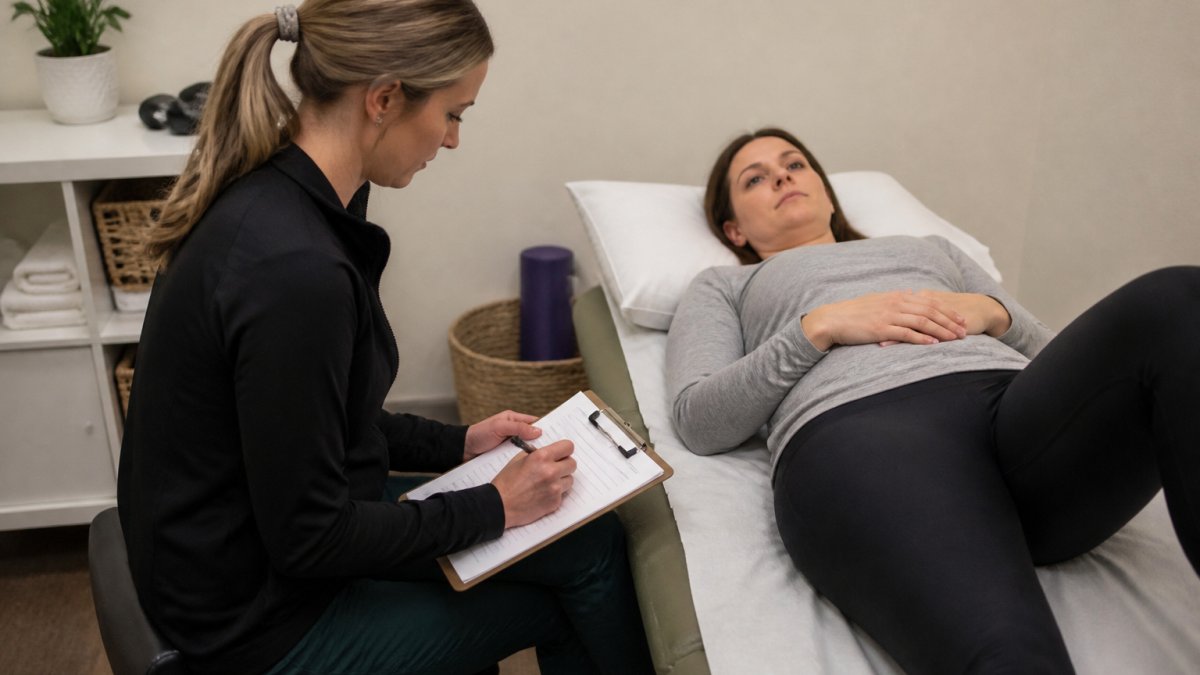
A proper pelvic floor assessment guides your recovery plan by identifying exactly which muscles are weak and which are overactive.
What happens during a physical therapy evaluation
Your physical therapist will ask detailed questions about your symptoms: when leakage started, what triggers it, how often it happens, and whether you have pelvic pain.
The therapist will examine your abdominal muscles and posture. Poor posture affects pelvic floor function. Abdominal weakness forces the pelvic floor to work harder.
You’ll be asked to contract your pelvic floor muscles so the therapist can feel how strong the contraction is and whether you can relax fully.
The assessment is brief, usually five to ten minutes.
How assessment guides your personalized recovery plan
Your assessment results determine your exercise program: a weak pelvic floor needs strengthening exercises, while an overactive, tight one needs relaxation techniques.
Most postpartum women need both. Early recovery focuses on gentle activation and awareness. Later stages add progressive strengthening. Throughout, relaxation techniques prevent overactivity.
Your therapist will show you how to perform each exercise, explain repetitions and frequency, and identify which daily activities to modify during early recovery.
Postpartum Pelvic Floor Exercises: Gentle Progression
Pelvic floor therapy after childbirth follows a careful progression. Start gentle. Build gradually. Listen to your body.
Early-stage contractions and breathing coordination
The first exercises focus on awareness and gentle activation, not strength. You’re learning to feel your pelvic floor and coordinate it with breathing.
Lie on your back with knees bent. Take a slow, deep breath in. As you exhale, gently squeeze your pelvic floor muscles.
Repeat this five to ten times. Do this once or twice daily.
Breathing coordination is essential. Many women hold their breath during contractions. This increases pressure on the pelvic floor.
As your awareness improves, try contractions in different positions. Sit upright. Stand. Walk. Your pelvic floor must work in all positions.
Kegel exercises and progressive strengthening
After two to four weeks of gentle activation, you can progress to Kegel exercises.
Contract your pelvic floor muscles as if stopping urine flow. Hold the contraction for five to ten seconds.
Do this exercise once or twice daily. Gradually increase the hold time. Work toward holding for ten seconds.
Progress to longer holds. Try holding for twenty seconds with full relaxation between contractions. This builds endurance.
Vary your routine. Do quick pulses: contract for one second, relax for one second, repeat rapidly. These quick contractions build power.
(Source: [statistics on pelvic floor dysfunction](https://www.statcan.gc.ca/eng/start))
Relaxation techniques for overactive pelvic floor
Many postpartum women have pelvic floor muscles that won’t relax.
Relaxation techniques are as important as strengthening. Deep breathing helps. Slow, diaphragmatic breathing activates your parasympathetic nervous system.
Try this: Breathe in slowly through your nose for four counts. Hold for four counts.
Gentle stretching helps too. Child’s pose stretches the pelvic floor. Kneel on the floor.
Pelvic floor relaxation exercises are different from contractions. Instead of squeezing, you’re learning to let go.
Heat helps. A warm bath or heating pad over your lower abdomen reduces muscle tension.
Postpartum Urinary Incontinence Treatment Options
Urinary leakage is the most common postpartum symptom. Many treatment options exist, from simple to advanced.
Conservative approaches: exercises, lifestyle, and pelvic floor therapy
Pelvic floor exercises are the first line of treatment. They work best when started early and practiced consistently.
Lifestyle changes support recovery. Limit caffeine, which irritates the bladder. Reduce fluids in the evening.
Avoid heavy lifting and straining. These increase pressure on the pelvic floor.
Pelvic floor therapy with a physical therapist accelerates results. A therapist teaches proper technique and monitors your progress.
At Core to Floor, we offer non-invasive PEMF treatment where patients remain fully clothed. This approach strengthens muscles while you remain fully clothed.
Advanced therapies and when they become appropriate
If conservative treatment doesn’t work after three to six months, advanced options exist.
Electrical stimulation uses gentle electrical currents to activate pelvic floor muscles. This helps women who cannot voluntarily contract the muscles.
Pessaries are devices inserted into the vagina to support the pelvic floor. They’re useful for prolapse or severe weakness.
Medications can help with urgency and frequency. They’re typically used alongside pelvic floor therapy, not instead of it.
Surgery is rarely needed for postpartum incontinence. It’s reserved for severe cases that don’t respond to conservative treatment.
Returning to Daily Activities and Exercise
Most women want to know when they can return to normal life. The answer depends on your symptoms and recovery progress.
Safe movement patterns during early recovery
During the first six weeks, avoid heavy lifting. Don’t lift more than your baby. Avoid straining during bowel movements. This increases pelvic floor pressure.
Walking is safe and beneficial. Start with short walks and gradually increase distance. Listen to your body.
Stairs are fine. Climbing stairs doesn’t harm your pelvic floor if your muscles are healing well.
Avoid high-impact activities like running or jumping. These increase pressure on healing muscles. Wait at least twelve weeks before returning to impact exercise.
Sex can resume when you feel ready, typically around six weeks. Communicate with your partner. Go slowly.
Progression from walking to higher-impact activities
Around twelve weeks postpartum, you can progress to more demanding activity. Start with low-impact options like stationary cycling or swimming.
Progress gradually. Do one new activity per week. Notice how your body responds. If leakage increases, you’re progressing too fast.
Running can resume around sixteen to twenty weeks if your pelvic floor is strong. Start with walk-run intervals.
Impact sports and high-intensity exercise should wait until at least six months postpartum.
Return to exercise is individual. Some women are ready sooner. Others need more time. Work with your physical therapist to determine your timeline.
Finding and Accessing Pelvic Floor Care
Quality pelvic floor care requires the right professional. Not all physical therapists specialize in pelvic health.
Types of qualified professionals and what to expect
Pelvic floor physical therapists are your best option. They specialize in pelvic floor dysfunction.
Look for credentials like PRPC (Pelvic Rehabilitation Practitioner Certified) or similar designations. These indicate specialized training.
Gynecologists can assess pelvic floor problems. However, they typically refer to physical therapists for treatment.
Urogynecologists specialize in urinary incontinence and pelvic floor disorders. They handle complex cases and advanced treatments.
When you contact a clinic, ask about their experience with postpartum recovery. Ask how they assess the pelvic floor.
Your first appointment should include a thorough history and assessment.
Cost, insurance coverage, and treatment frequency
Pelvic floor therapy costs vary. Many insurance plans cover pelvic floor physical therapy with a referral from your doctor. Check your coverage before starting treatment.
At Core to Floor, our non-invasive PEMF approach is supervised by the Barrie Urology Group, ensuring your care is medically backed and clinically sound.
Pelvic floor recovery after childbirth takes time and consistency. Most women regain full function within six months with proper treatment. Early assessment and appropriate exercise make the difference.
Frequently Asked Questions
How long after childbirth can I start pelvic floor therapy?
The timing depends on your birth experience and healing. After vaginal birth without significant tearing, gentle pelvic floor exercises can begin within the first two weeks once bleeding has substantially decreased. After cesarean delivery, wait four to six weeks before starting therapy. If you experienced severe tearing, episiotomy, or perineal trauma, your healthcare provider may recommend waiting six to eight weeks. Always get clearance from your doctor before beginning any pelvic floor therapy after childbirth.
Can pelvic floor therapy help with urinary leakage after childbirth?
Yes. Postpartum urinary incontinence treatment through pelvic floor therapy is one of the most effective conservative approaches. Strengthening and retraining pelvic floor muscles restores bladder control for many women. Studies show that structured pelvic floor exercises reduce leakage significantly. If leakage persists after three to six months of consistent practice, or if you experience severe symptoms, a pelvic floor physiotherapist can assess whether additional interventions are needed.
What is the difference between pelvic floor therapy after vaginal birth versus cesarean birth?
After vaginal birth, pelvic floor muscles experience direct stretching and potential micro-tears, so therapy focuses on gentle reactivation, then progressive strengthening. After cesarean delivery, pelvic floor muscles are largely intact but may be weakened from pregnancy itself and immobility during recovery. Cesarean recovery requires longer initial rest before starting therapy, typically four to six weeks. Both require assessment and individualized guidance, but the progression and intensity differ based on tissue healing.
Do I need to see a specialist for pelvic floor assessment after childbirth?
A pelvic floor assessment after childbirth by a qualified physical therapist or pelvic health specialist is highly recommended, especially if you experience symptoms like leakage, heaviness, or pain. Assessment identifies muscle weakness, tension, scar tissue restrictions, or other issues that guide your specific treatment plan. Your family doctor can provide initial screening, but a specialist’s detailed evaluation ensures your recovery plan matches your individual needs and birth experience.