

Table of Contents
- Understanding Pelvic Floor Muscles and Their Role in Bladder Control
- What PEMF Therapy Is and How It Works
- Kegel Exercises for Urinary Incontinence: Mechanism and Effectiveness
- How Long Do Kegel Exercises Take to Work
- PEMF Therapy for Urinary Incontinence: Evidence and Outcomes
- Direct Comparison: PEMF Therapy Versus Kegel Exercises
- Which Approach Is Right for You
- Frequently Asked Questions
Last Updated: October 18, 2026
Understanding Pelvic Floor Muscles and Their Role in Bladder Control
The pelvic floor muscles are a group of tissues that stretch across the bottom of your pelvis. When these muscles weaken, you may experience leakage during exercise, coughing, or sneezing. (Source: prevalence of urinary incontinence)
Strong pelvic floor muscles help you control when urine leaves your body. They act like a valve. When they tighten, they stop the flow. When they relax, they allow normal urination.
Urinary incontinence happens when pelvic floor muscles lose strength or tone. This is common after pregnancy, during menopause, or as you age. It’s also common after prostate surgery in men.
What PEMF Therapy Is and How It Works
PEMF therapy stands for pulsed electromagnetic field therapy. It uses magnetic pulses to stimulate your pelvic floor muscles without any invasive procedures. You remain fully clothed during treatment.
Here’s how it works:
- Electromagnetic pulses are delivered to the pelvic floor area
- The pulses trigger muscle contractions automatically
- Your muscles respond by strengthening and improving tone
- Sessions typically last 20-30 minutes
Unlike voluntary exercise, PEMF therapy creates involuntary muscle contractions. This means your muscles work even if you can’t consciously control them well.
At Core to Floor, we use advanced PEMF technology supervised by the Barrie Urology Group. Our protocols are shaped by urologists to ensure safety and effectiveness.
Kegel Exercises for Urinary Incontinence: Mechanism and Effectiveness
Kegel exercises are voluntary pelvic floor muscle contractions you perform yourself. You squeeze the muscles you use to stop urination mid-stream, hold for a few seconds, then relax.
The mechanism is straightforward:
- You identify your pelvic floor muscles
- You contract them deliberately for 2-3 seconds
- You relax them completely for 2-3 seconds
- You repeat this cycle 10-20 times, several times per day
Kegels work by building muscle strength through repeated voluntary effort. Over time, your pelvic floor becomes stronger and more responsive. Many people see improvement in bladder control.
However, Kegels require discipline and proper technique. Many people perform them incorrectly, which limits results. Some people struggle to identify the right muscles.
How Long Do Kegel Exercises Take to Work
Most people need to perform Kegel exercises consistently for 4-6 weeks before noticing improvement. Some see changes earlier. Others take longer.
The timeline depends on several factors:
- Your starting level of muscle weakness
- How consistently you perform the exercises
- Whether you’re using the correct technique
- Your age and overall health
- Whether you combine Kegels with other treatments
Many people stop doing Kegels before seeing results because the improvement is gradual. You won’t feel immediate change like you might with other treatments.
This is where adherence becomes a real challenge. Life gets busy. You forget your routine. A few missed days turns into weeks. Before long, you’ve abandoned the exercise completely.
PEMF Therapy for Urinary Incontinence: Evidence and Outcomes
PEMF therapy has been studied for its effects on pelvic floor strength and urinary symptoms, but the evidence base is uneven, and the quality of that evidence matters more than the headline claims. A useful way to read the research is to separate three things: what technology was actually tested, what outcome was measured, and how certain the finding is.
First, clarify which technology is being discussed
The terms used in this space are often blurred, and that blurring inflates claims. Three distinct technologies appear in the literature and in clinic marketing:
- Pulsed electromagnetic field (PEMF) therapy, low-intensity magnetic pulses, typically delivered through a chair or pad, intended to stimulate tissue and improve circulation and muscle response. Sessions are usually 20-30 minutes.
- High-intensity electromagnetic stimulation (HIES), sometimes marketed as HIFEM or under brand names. This delivers much stronger fields that force supramaximal pelvic floor contractions. It is a different device class with a different risk profile from low-intensity PEMF.
- Electrical muscle stimulation (EMS), uses electrical current, often via a vaginal or anal probe, to trigger contractions. It is not magnetic, and evidence from EMS studies should not be transferred to PEMF devices.
A common error in consumer articles is to cite a HIES or EMS trial as proof that “PEMF works.” When you read a study, check the device type, the field intensity, and the treatment protocol before accepting the conclusion.
What the evidence generally shows
Across the published literature, the most consistent finding is that electromagnetic stimulation of the pelvic floor can produce measurable contractions and, in several trials, improve pelvic floor muscle strength and reduce leakage episodes compared with no active treatment. Trials that combine electromagnetic stimulation with a supervised pelvic floor muscle training program tend to report larger gains than training alone, which is consistent with the idea that stimulation and voluntary exercise work through complementary pathways.
What the evidence does not reliably show:
- That PEMF outperforms well-supervised pelvic floor muscle training as a first-line treatment.
- That results persist after treatment stops without ongoing maintenance.
- That one device protocol is equivalent to another. Session frequency, field strength, and duration vary widely between studies, so results are not interchangeable.
How to grade the evidence yourself
When you encounter a claim about PEMF and incontinence, apply four quick checks:
- Study design, Was it a randomized controlled trial, a before-and-after study, or a case series? Only the first can support a causal claim with reasonable confidence.
- Comparator, Was the comparison against sham treatment, against pelvic floor muscle training, or against nothing? Comparisons against nothing overstate benefit.
- Outcome measure, Was the outcome validated (for example, a standardized leakage or quality-of-life questionnaire) or self-reported informally?
- Sample and duration, Small, short trials can show promising signals but cannot establish durable benefit.
Most practitioners would describe the current evidence as promising but not definitive, enough to justify a trial of therapy in the right patient, not enough to present it as a proven replacement for supervised pelvic floor training.
The honest summary: electromagnetic stimulation has plausible mechanisms and supportive trials, but the certainty is moderate at best, and the technology label on the device matters. Ask which device, which protocol, and which outcome before accepting any efficacy claim.
Mechanism pathways worth understanding
The proposed mechanisms are reasonable and worth knowing, because they explain why stimulation and exercise are often combined rather than treated as rivals: (Source: scientific literature on PEMF therapy)
- Direct muscle activation, forced contractions recruit motor units that some people cannot voluntarily engage.
- Circulation, improved local blood flow is thought to support tissue recovery.
- Neuromuscular re-education, repeated stimulation may help restore signaling between nerve and muscle.
- Motor learning, the sensation of a correct contraction can help patients find the right muscles during subsequent voluntary training.
That last point is clinically important: stimulation is often most useful as a teaching tool that makes subsequent Kegels more effective, not as a standalone cure.
Practical protocol expectations
Typical clinic protocols run 20-30 minutes per session, two to three times per week for four to six weeks, with reassessment afterward. Some patients notice change within the first few weeks; others need the full course. Because protocols vary by device, the schedule you are offered should be explained in terms of the specific equipment being used, not a generic promise.
pelvic floor muscle training guidance
Direct Comparison: PEMF Therapy Versus Kegel Exercises
| Aspect | PEMF Therapy | Kegel Exercises |
|---|---|---|
| Muscle Stimulation | Involuntary electromagnetic contractions | Voluntary conscious contractions |
| Time Commitment | 20-30 min sessions, 2-3x per week | 5-10 min daily or multiple times daily |
| Technique Barrier | No special technique required | Requires proper muscle identification |
| Adherence Challenge | Clinical appointments required | Easy to skip or forget |
| Results Timeline | Often 2-3 weeks | Typically 4-6 weeks |
| Setting | Professional clinic | Home-based |
| Supervision | Medical specialist oversight | Self-directed |
Muscle Stimulation Method
PEMF therapy and Kegel exercises stimulate your pelvic floor muscles in fundamentally different ways.
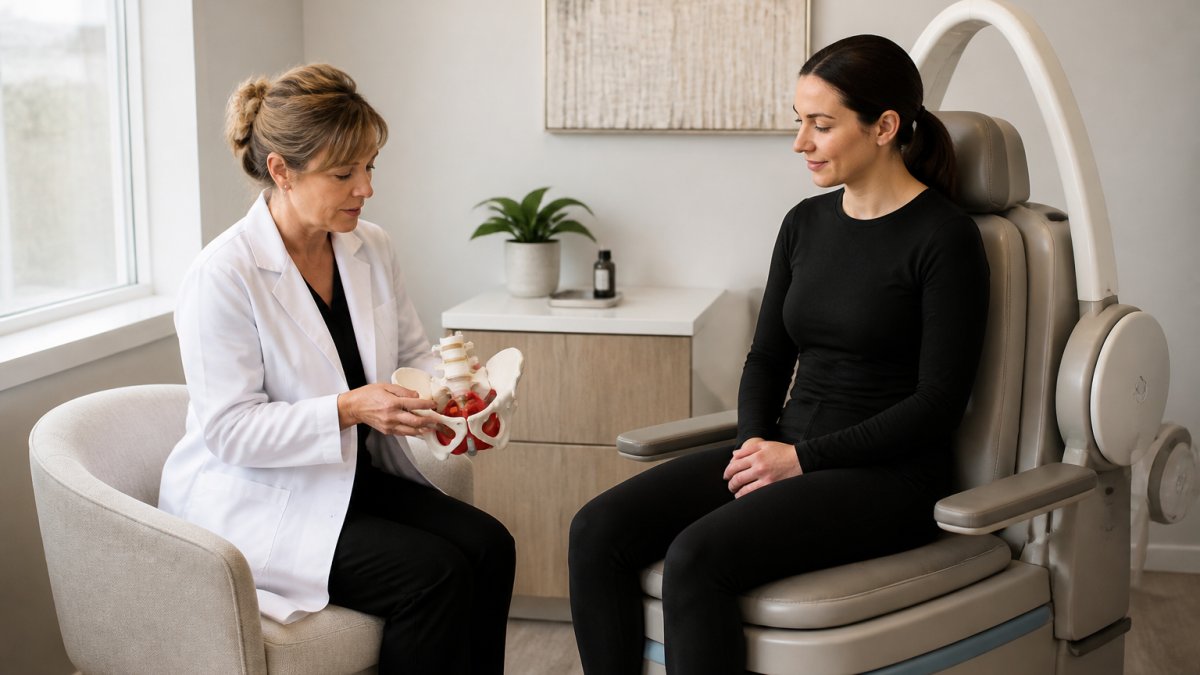
Kegel exercises rely on your ability to consciously contract the right muscles.
PEMF therapy uses electromagnetic pulses to create involuntary contractions. Your muscles respond to the magnetic field automatically, regardless of your conscious effort.
This distinction matters significantly. People with severe weakness or neurological issues often struggle with Kegels because they can’t generate enough voluntary force.
Time Commitment and Adherence
Kegel exercises demand daily commitment. Standard protocols recommend 10-20 repetitions, 3-5 times per day. That’s roughly 5-10 minutes daily minimum.
Life interrupts consistency. You forget your morning routine. Work stress derails your afternoon session. By evening, you’re too tired.
PEMF therapy requires scheduled clinic appointments, typically 2-3 times per week. This creates external accountability. You have an appointment. You go. The treatment happens.
Research shows that people are more likely to stick with treatments that don’t depend on daily willpower.
Treatment Duration and Results Timeline
Kegel exercises typically require 4-6 weeks of consistent practice before noticeable improvement appears. Some people see changes at 3 weeks. Others wait 8 weeks. The gradual nature of improvement can feel discouraging.
PEMF therapy often produces noticeable results within 2-3 weeks.
Both approaches usually require ongoing maintenance. Stopping either treatment eventually leads to muscle weakening again.
Safety and Contraindications
Kegel exercises are generally safe for most people. The main risks involve incorrect technique, which can strain other pelvic structures or create tension rather than strength.
PEMF therapy is also safe for most people, but certain conditions warrant caution.
At Core to Floor, every patient receives evaluation by medical specialists before beginning PEMF therapy. This ensures the treatment is appropriate for your specific situation and medical history.
Which Approach Is Right for You
Your best choice depends on your specific situation, preferences, and constraints.
Choose Kegel exercises if:
- You prefer home-based treatment with no appointments
- You have consistent daily discipline and can maintain a routine
- You respond well to self-directed care
- You want to start immediately without scheduling
- Your pelvic floor weakness is mild
Choose PEMF therapy if:
- You’ve tried Kegels and seen limited improvement
- You struggle with daily exercise routines or motivation
- You want faster results in fewer weeks
- You prefer professional supervision and guidance
- You have difficulty identifying or controlling pelvic floor muscles
- You’re dealing with moderate to severe incontinence
Many people benefit most from combining both approaches. PEMF therapy provides the muscle stimulation and faster initial improvement.
At Core to Floor, we work with patients to create treatment plans tailored to their needs. Our urologist-founded clinic offers PEMF therapy supervised by the Barrie Urology Group.
The key is choosing an approach you’ll actually stick with. A treatment that produces results only works if you complete it.
Frequently Asked Questions
What is the difference between PEMF therapy and Kegel exercises?
Kegel exercises rely on voluntary muscle contractions that you perform manually to strengthen pelvic floor muscles. PEMF therapy uses pulsed electromagnetic fields to stimulate involuntary muscle contractions without conscious effort. Kegels require discipline and proper technique; PEMF delivers consistent stimulation through electromagnetic pulses. Both aim to increase pelvic floor muscle strength and tone, but the method of activation differs fundamentally.
Can you do Kegel exercises and PEMF therapy together?
Yes, combining both approaches is common in pelvic floor therapy. In clinical practice, PEMF therapy often complements pelvic floor training rather than replacing it. Research shows that women who added PEMF to pelvic floor training gained significantly more strength and reported reduced leakage compared to those training alone. Your healthcare provider can advise whether combining both methods suits your specific condition and treatment goals.
How long does it take for pelvic floor exercises to work?
Kegel exercises typically require 4 to 6 weeks of consistent practice before noticeable improvement in urinary symptoms. Many people see meaningful changes within 8 to 12 weeks of regular training. Results depend on starting strength, exercise frequency, and proper technique. Some individuals notice benefits earlier; others require longer commitment. Adherence is critical, skipping sessions delays results. If you see no improvement after 12 weeks of correct practice, consult a pelvic floor physiotherapist to assess your technique or explore additional options like PEMF therapy.
Is PEMF therapy effective for urinary incontinence?
Clinical evidence supports PEMF therapy for reducing urinary incontinence symptoms. A 2022 randomised trial demonstrated that women using PEMF therapy alongside pelvic floor training experienced significantly greater strength gains and reported far less leakage than those training alone. PEMF therapy works by stimulating pelvic floor muscle contractions and promoting blood flow and cellular repair. Results vary by individual and condition severity, and PEMF is most effective as part of a supervised, medically directed treatment plan rather than as a standalone solution.
If you’re experiencing urinary leakage, urgency, or pelvic floor weakness, PEMF therapy offers a clinically backed, non-invasive option. At Core to Floor, our medical specialists will evaluate your situation, explain your options, and create a personalized treatment plan. We’ve helped many people regain confidence and reduce symptoms through evidence-based pelvic floor therapy. Book a demo with our team to learn whether PEMF therapy is right for you.