

Table of Contents
- Understanding Incontinence Cost Savings Across Life Stages
- Urinary Incontinence After Childbirth Treatment Options
- How to Manage Urine Leaks During Pregnancy and Postpartum
- Perimenopause Urinary Incontinence Treatment and Hormonal Changes
- Incontinence Products and Treatment Costs: A Side-by-Side Comparison
- Decision Guide: Matching Support to Your Symptom Type and Severity
- Conclusion: Choosing the Best Support for Incontinence Cost Savings
- Frequently Asked Questions
Last Updated: October 9, 2026
Understanding Incontinence Cost Savings Across Life Stages
Urinary incontinence is the involuntary loss of bladder control, from occasional leaks when you cough or sneeze to a sudden, strong urge.
That’s where incontinence cost savings becomes a planning question rather than a budgeting afterthought.
Below, we break down what each life stage demands, compare the main support options, and show where supervised care can reduce spending over time.
Why the Total Cost of Leaks Adds Up
A single pack of pads looks harmless. The problem is frequency: someone managing daily leakage may go through several pads a day, every day, for months.
Then there’s the invisible layer: missed work, skipped events, and the cost of trying one over-the-counter fix after another.
A product that contains a leak is a recurring cost. A treatment that improves bladder control can taper off.
Urinary Incontinence After Childbirth Treatment Options
Urinary incontinence after childbirth treatment options fall into three groups: conservative pelvic-floor training, supervised therapy, and surgery for cases that don’t respond.
Pelvic-floor muscle training, or Kegels, is the standard first step: free, private, and effective when done correctly. The catch is that “correctly” is doing a lot of work.
That’s the frustration we hear most: months of Kegels with no improvement. It usually isn’t discipline, it’s technique and feedback.
Supervised Therapy and At-Home Exercises
Supervised therapy pairs at-home exercises with professional assessment, so someone qualified checks you’re activating the right muscles and adjusts the program as you progress. Pelvic-floor physical therapy is the most established version.
Core to Floor is urologist-founded and operates inside the Barrie Urology Clinic, with protocols shaped and supervised by the Barrie Urology Group.
A 2022 randomised trial (Elhosary EA, et al.
If you’ve done Kegels for months with no change, the issue is usually coordination, not effort. Ask for an assessment before you conclude that exercises don’t work for you.
How to Manage Urine Leaks During Pregnancy and Postpartum
Managing urine leaks during pregnancy and postpartum starts with protecting the pelvic floor while it’s under load, not pushing it harder. Pregnancy is itself a risk factor: the growing uterus presses on the bladder, hormonal changes affect tissue tone, and vaginal delivery can stretch or injure pelvic-floor muscles.
Practical steps that help:
- Empty your bladder before exercise, long walks, or car trips
- Treat constipation early, since straining weakens the same muscles
- Use pads or protective underwear for peace of mind, not as a long-term plan
- Start gentle pelvic-floor activation after clearance from your care provider
Recovery timelines vary. Some notice symptoms easing within weeks of delivery; others find leakage persists beyond the first year. Persistent symptoms are common and treatable, not something to live with.
HealthLink BC on urinary incontinence in women
Perimenopause Urinary Incontinence Treatment and Hormonal Changes
Perimenopause urinary incontinence treatment begins with understanding why symptoms appear or return years after childbirth. Falling estrogen affects the bladder and urethra lining, reducing tissue support, and pelvic-floor muscles may lose strength with age.
What makes perimenopause different is duration. Pregnancy-related leakage has a defined endpoint, delivery plus recovery. Perimenopause can span years, which changes the cost math: a containment-only strategy affordable for six months becomes expensive over five.
Why the Hormonal Driver Changes the Plan
Estrogen decline affects the urethra and bladder lining, not just the pelvic-floor muscles, so pelvic-floor training alone may not fully address symptoms the way it can after childbirth. A combined approach works better:
- Pelvic-floor muscle training, ideally supervised so technique is verified
- Bladder training to reduce urgency and frequency
- Dietary adjustments, since caffeine and alcohol can irritate the bladder
- Non-invasive therapies such as PEMF for those who want to avoid surgery
- Medical review of medications and other contributing conditions
Perimenopause deserves its own plan, because the hormonal driver differs from the mechanical strain of pregnancy and delivery. The same pelvic-floor work helps, but the context, and the cost horizon, changes.
Cost Planning for a Multi-Year Stage
Because perimenopause symptoms can persist for years, containment products remain a recurring, indefinite expense, while supervised therapy and non-invasive clinic care are time-limited costs that taper as symptoms improve. Over a multi-year window, the time-limited option is often the lower total spend, even when the per-session fee looks higher upfront. (Source: pelvic floor muscle training)
Coverage considerations specific to this stage:
- Extended health benefits: Pelvic-floor physiotherapy coverage often resets annually, so you may be able to spread treatment across two plan years to maximize reimbursement. Check your plan’s annual maximum and whether a referral is required.
- Health spending accounts: If you have an HSA, perimenopause is a stage where using it for therapy may make more sense than using it for supplies, because therapy has the potential to reduce future spending.
- Prescription-related costs: If a clinician recommends local estrogen therapy, confirm whether it’s covered under your provincial drug plan or extended health plan, since coverage varies.
- Tax claims: Keep receipts for therapy and supplies; medical expenses above the threshold may be claimable.
Perimenopause is the stage where containment costs accumulate the longest. If symptoms have been managed with pads for more than a year, it’s worth pricing out a supervised treatment course against your projected annual containment spend.
HealthLink BC on urinary incontinence in women
Incontinence Products and Treatment Costs: A Side-by-Side Comparison
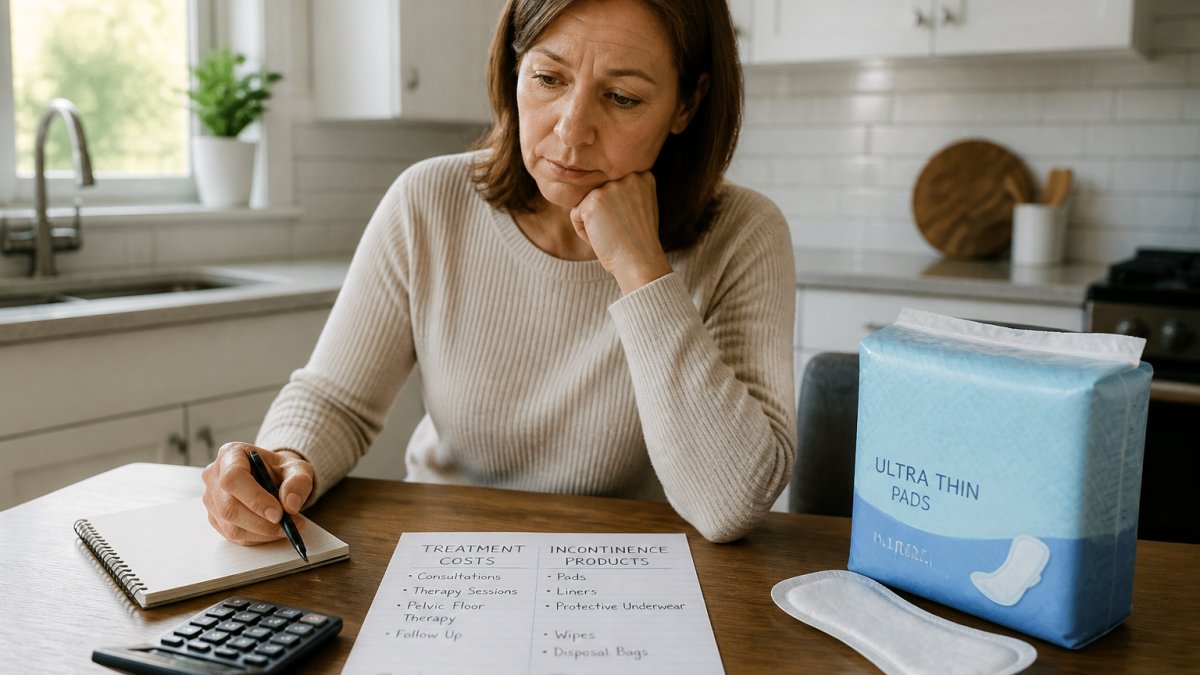
Incontinence products and treatment costs vary enormously, and the biggest variable isn’t sticker price, it’s whether the option is a recurring containment cost or a time-limited treatment cost.
| Option | Cost Pattern | Ongoing Cost | Best For |
|---|---|---|---|
| Pads and liners | Low upfront | Recurring, indefinite | Day-to-day containment |
| Protective underwear | Moderate upfront | Recurring, indefinite | Heavier leakage, overnight |
| At-home Kegels | Free | None | Mild symptoms, good technique |
| Pelvic-floor physical therapy | Per-session fees | Tapers with progress | Technique correction, moderate symptoms |
| Non-invasive clinic therapy | Per-session fees | Tapers with progress | Those wanting to avoid surgery |
| Surgical procedures | Highest upfront | Follow-up visits | Symptoms unresponsive to conservative care |
What the Numbers Look Like by Life Stage
Costs cluster differently by life stage, because the duration of need changes.
- Pregnancy: Usually a shorter window, often the third trimester through a few weeks postpartum. The dominant cost is containment (pads, liners, protective underwear) plus any maternity-related clothing replacement. Pelvic-floor physiotherapy may be recommended but is often deferred until after delivery.
- Postpartum: This is where the cost curve splits. If symptoms resolve in the first few months, spending stays low. If leakage persists past the first year, containment costs compound month after month, and supervised therapy becomes the cheaper path over a multi-year horizon.
- Perimenopause: Symptoms can return or worsen and may last years, not months. That long duration is what makes containment the most expensive option per year, even though it’s the cheapest per unit.
A useful rule of thumb: multiply your monthly containment spend by 12, then by the number of years you expect to manage symptoms. Compare that total against a course of supervised therapy that tapers off. Most people find the containment number is larger than they assumed.
Coverage and Cost Savings: What to Verify in Your Plan
Coverage in Canada isn’t uniform, so check your own plan before assuming anything. The main levers:
- Extended health benefits (group or individual): Many plans cover pelvic-floor physiotherapy when there’s a referral or prescription, but annual maximums, per-visit caps, and referral requirements vary widely by insurer and plan. Call your insurer and ask specifically about pelvic-floor physiotherapy, not just “physiotherapy.”
- Health spending accounts (HSAs): If your employer offers an HSA, it may reimburse eligible paramedical services, including physiotherapy, and sometimes continence supplies with a prescription. Confirm which categories are eligible.
- Provincial health coverage: Medically necessary surgical procedures are covered under provincial health insurance, but conservative therapies like pelvic-floor physiotherapy are generally not covered by the provincial plan itself, they fall to extended health or out-of-pocket.
- Continence supplies: Some plans reimburse pads, liners, or protective underwear with a prescription or a note from a clinician. This is plan-specific and often overlooked.
- Tax credits: Medical expenses above a threshold may be claimable on your tax return, including some continence supplies and therapy. Keep receipts.
Canadian Continence Foundation resources
Pads, Devices, and Clinic-Based Care
Pads and devices manage the symptom; clinic-based care aims to change it. A box of pads will never reduce how much you leak, no matter how long you use it.
For cost planning, ask three questions before committing to any option:
- Is this a recurring cost or a time-limited one?
- Does it address the cause or only the symptom?
- What happens to my spending if it works?
For clinic-based care, contact the provider for current fees, since pricing varies by clinic and region. Ask whether the clinic provides itemized receipts suitable for insurance reimbursement or tax claims.
Buying in bulk to save per unit is a false economy if the product only contains symptoms. You can spend less per pad and more per year. Compare annual cost, not unit cost.
Decision Guide: Matching Support to Your Symptom Type and Severity
Match your support to your symptom pattern, not to what’s on sale:
- Occasional leaks when coughing, sneezing, or exercising: Start with supervised pelvic-floor training. Containment products for convenience.
- Urgency and frequency, hard to reach the bathroom in time: Bladder training plus pelvic-floor work. Ask about non-invasive therapy.
- Heavy or daily leakage: Protective underwear alongside a clinical assessment, not instead of one.
- Symptoms returning during perimenopause: Treat it as a new problem with a hormonal component. Get reassessed.
- No improvement after months of Kegels: Get a technique assessment before assuming exercises don’t work.
On evidence quality, be realistic: conservative approaches work well for many, but a specific outcome cannot be promised. The 2022 trial showed meaningful gains when PEMF was added to training, a fair basis for trying it, not a guarantee.
Conclusion: Choosing the Best Support for Incontinence Cost Savings
The best support for pregnancy, postpartum, and perimenopause for incontinence cost savings is the one that reduces symptoms rather than only containing them, because containment costs never end. Cheap per unit and cheap per year are different numbers, and the gap widens the longer symptoms go unaddressed.
If you’ve been managing this quietly with pads and hope, a proper assessment is the step that changes the math.
Frequently Asked Questions
How can I manage urine leaks during pregnancy and postpartum without breaking the bank?
Start with low-cost habits: timed voiding every two to three hours, avoiding caffeine and heavy lifting, and doing pelvic-floor muscle training daily. Over-the-counter pads manage leaks while you build strength. If symptoms persist, ask a urologist-supervised clinic about supervised pelvic-floor physical therapy or non-invasive options like PEMF. In a 2022 randomised trial, women who added PEMF to pelvic floor training gained significantly more strength and reported far less leakage than those training alone. A supervised plan can reduce long-term spending on pads and repeated appointments.
What should I compare when choosing an incontinence treatment for perimenopause?
Compare four things: whether the provider is medically supervised (urologist-led care is safer for prolapse or urgency), whether the approach is conservative first (pelvic-floor training, PEMF, lifestyle changes) before surgery, how many sessions you need and how long each takes, and what your extended health coverage will reimburse. Perimenopause urinary incontinence treatment often combines pelvic-floor muscle training with hormonal changes management discussed with your doctor. Ask for a written plan with expected timelines so you can weigh total costs against symptom relief.
Does extended health coverage pay for pelvic-floor therapy or support devices?
Coverage varies by insurer and plan. Many extended health plans in Canada partially reimburse pelvic-floor physical therapy when prescribed by a physician or nurse practitioner, but classification for non-invasive treatments like PEMF can vary. Before booking, call your insurer and ask: Is this provider covered? Do I need a referral? What percentage is reimbursed and what is the annual maximum? Some plans also cover compression garments or support devices with a prescription. Getting pre-approval prevents surprise bills.
How do I know if I need pelvic-floor physical therapy or just Kegel exercises?
Kegel exercises work for mild stress urinary incontinence when done correctly, but many people perform them with poor muscle coordination and see no change. If you have been doing Kegels for months with no improvement, or if you have urgency, pelvic organ prolapse symptoms, or leakage after prostate surgery, supervised pelvic-floor physical therapy is more effective. A qualified professional can assess muscle strength and coordination, use biofeedback, and tailor at-home exercises. Supervised therapy often reduces the number of pads needed and may lower long-term product costs.